Introduction
An answer-focused assistant can explain the options. An agent-based experience can also bring a relevant service and a supported next step into view. The actions available depend on the product and its setup.
When comparing an AI chatbot with an AI agent for a website, focus on the work the system can complete, the information it can access and the permissions it has. The product label alone tells you very little.
What is an AI chatbot
An AI chatbot is a conversational interface that uses AI to respond to messages. On a business website, it might explain services, find an answer in a knowledge base or help visitors navigate a catalog.
Some chatbots mainly provide answers. Others connect to business systems and can retrieve account information or trigger workflows. A chatbot does not become incapable of taking action simply because the vendor calls it a chatbot.
For evaluation, “answer-focused chatbot” is a useful description of a system whose main job is supplying information and directing the visitor to the next destination.
What is an AI agent
An AI agent uses a model and connected tools to work toward a goal. Depending on its design and permissions, it can choose next steps, retrieve information, carry out supported actions and use the results to decide how to continue.
There is no universal boundary between the marketing terms. Anthropic’s guide to effective agents distinguishes predefined workflows from agents that dynamically direct their processes and tool use. That distinction is more useful than assuming every conversational product has the same capabilities.
A fixed booking workflow can be exactly what a business needs. More autonomy is valuable only when the task benefits from it.
The practical differences
| Evaluation area | Answer-focused chatbot | Tool-connected website agent |
|---|---|---|
| Main job | Explain, answer and guide | Help complete a supported goal |
| Information | Often uses a maintained knowledge base | May combine knowledge with current business-system data |
| Customer actions | Usually links to another form or workflow | Can prepare or perform authorized actions through connected tools |
| Setup priorities | Accurate content and clear escalation | Accurate content, integrations, permissions and reliable action handling |
| Useful success measure | Correct resolution of the question | Correct completion of the task, including necessary approvals |
These are evaluation patterns, not rigid product categories. Ask each provider to demonstrate its actual capabilities using your own scenario.
What the difference looks like in three businesses
A shop helping someone choose a product
A customer asks, “Will this camera bag fit my camera and two lenses?”
An answer-focused chatbot could explain the published dimensions and link to the specification page. That is useful if the customer needs clarification.
A connected agent could ask which equipment the customer owns, retrieve verified product information and compare suitable options. Check whether the chosen platform supports stock checks and cart actions, and where that information comes from.
The important test is how it handles missing information. It should not guess that unfamiliar equipment will fit or invent stock availability to keep the conversation moving. For purchasing, the customer should see the correct item, variant, quantity and price before approving the transaction.
A service business helping someone book an appointment
An answer-focused chatbot could explain opening hours, cancellation terms and how to contact the team. For many routine questions, that may be sufficient.
For a new appointment, an adaptive experience can bring a relevant service and booking choices together. Check how the platform handles availability, confirmation and changes after booking.
A booking is complete only when the booking system confirms it. A friendly sentence saying “You’re all set” is not evidence that the action succeeded. Test what happens if a selected time becomes unavailable or the connection fails.
A course business advising a prospective learner
An answer-focused chatbot could explain the difference between a beginner course and an advanced program.
A connected agent could use the learner’s stated goals, preferred format and availability to narrow the options. Consider how the platform handles enrollment and returning to purchased content.
The system needs clear limits. Recommending a course does not authorize a payment, and recognizing a customer’s name does not establish access to private learning records. Technical checks must enforce identity and content permissions.
These examples describe possible implementations. They are not promises that every website agent offers these functions out of the box.
Choose based on where customers get stuck
Choose a simpler answer focused system when information is the problem
If visitors repeatedly ask about service areas, product care or what a workshop includes, a reliable knowledge-based assistant may solve the immediate need.
Before adding one, consider whether the information should also be easier to find on the page. A clearer description or better navigation can prevent the question entirely.
Consider an agent when the task spans several steps
An agent may be useful when customers need to identify the right offer, check changing information and take a supported action without repeatedly starting over.
The business must be ready to maintain the systems behind that experience. An agent cannot reliably compensate for conflicting prices, an outdated calendar or unclear eligibility rules.
Keep conventional controls for straightforward tasks
Customers who know what they want should still be able to search, browse or book directly. A date picker may be faster than a conversation for someone who has already chosen a service.
The strongest design may combine conversation with familiar controls. Let the customer move between them without losing their selections.
Where generative UI fits
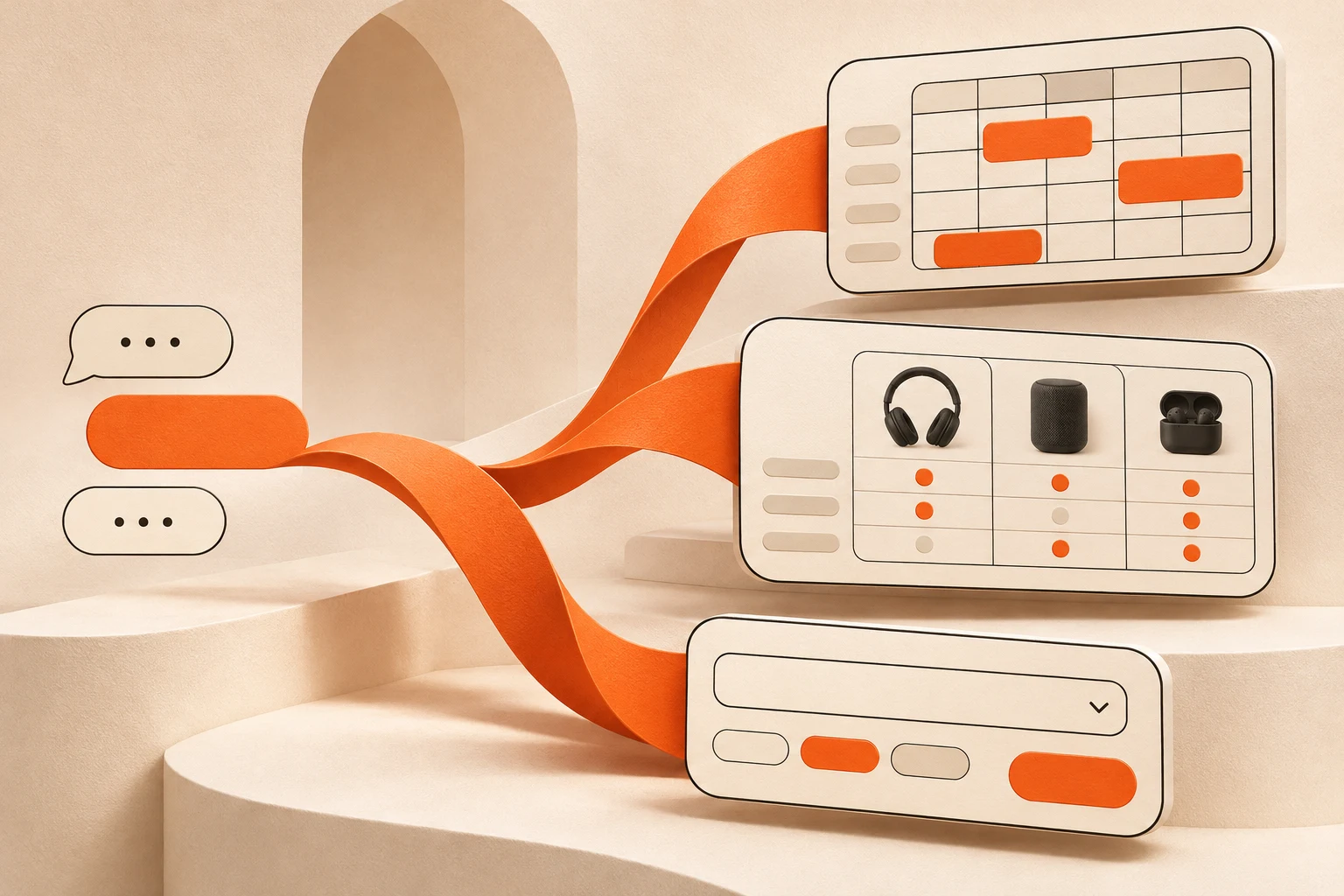
An agent’s work and its visual presentation are separate design choices. The same result could appear as a paragraph, a product comparison or a booking panel.
Generative UI brings relevant interface elements into the experience as the request develops. For example, after a customer explains their scheduling constraints, the site could show an appropriate date picker beside the service details.
Evaluate this separately from agent capabilities. An attractive booking card is not proof of a live calendar connection. Likewise, a capable agent may be awkward to use if it describes every option in a long block of text.
The controls a website agent needs
Start by writing down the actions it may take, the information each action requires and the situations that need human help.
At minimum, establish:
- Limited permissions. Give the system access only to the records and actions needed for its job.
- Identity checks. Verify the customer before accessing private orders, bookings or purchased content.
- Review steps. Make charges and important changes visible before the customer approves them.
- Independent validation. Enforce eligibility, price and access rules in the business systems, not just in a model’s instructions.
- Action records. Keep enough evidence to investigate what was requested, attempted and confirmed.
These controls align with OWASP’s guidance on excessive agency, which addresses the risks of excessive functionality, permissions and autonomy.
Also design the human handoff. Give staff the relevant context, make the unresolved issue clear and explain to the customer what happens next. If a system cannot confirm whether an action succeeded, check the underlying record before repeating it.
Compare operating effort as well as subscription price
An agent can involve more operational work than an answer-focused assistant. Model usage, external service calls, hosting, integration maintenance, testing and exception handling all contribute to cost.
Anthropic also notes that agentic systems can trade additional latency and cost for better task performance. The right comparison is the total cost of a useful outcome, not the monthly headline price alone.
For a pilot, track completed tasks, failed actions, staff interventions and maintenance time alongside usage fees. Avoid treating every conversation as a successful resolution. A visitor who stops responding may have found the answer, abandoned the task or switched to another channel.
Five questions to ask before choosing a provider
- Can you show the exact journey our customers need? Use a real product, service or course structure rather than a generic demonstration.
- Which facts are current, and where do they come from? Ask how price, availability and policy updates reach the assistant.
- What can the system actually change? Request a clear list of supported actions, required integrations and approval steps.
- What happens when something goes wrong? Test unavailable items, ambiguous requests, failed connections and interrupted transactions.
- How will we know it helped? Agree on task completion, accuracy and escalation measures before rollout.
Use the answers to scope a small trial. One dependable customer journey is a stronger starting point than a long list of loosely defined capabilities.
Where PAKA fits
PAKA describes a combination of an AI agent and an adaptive canvas for businesses selling products, bookings, courses and other offers. Its public positioning emphasizes connecting conversation, relevant content and supported actions within one experience.
Evaluate that approach against a specific journey in your business. Confirm current availability, required connections and the boundaries around each action before planning a rollout.
Frequently asked questions
Can an AI chatbot also be an AI agent
Yes. Chatbot describes the conversational interface, while agent describes capabilities and behavior behind it. A product can be both. Ask what it can access and do rather than relying on the name.
Does an AI agent work without human approval
It can perform some permitted tasks automatically, but autonomy should be limited by the action and its consequences. Customers should have clear review and approval steps for purchases or important changes, and businesses should define escalation rules.
Is an AI agent always better than a chatbot
No. A reliable answer-focused assistant may be simpler and more appropriate when the main need is information. Choose additional capabilities when they solve a specific customer problem and can be operated reliably.
Can an agent replace a booking or commerce system
The agent is not automatically the system of record. It may rely on a booking platform, catalog, payment provider or learning platform to validate and complete work. Check which systems a product includes and which it must connect to.
Start with the outcome your customer needs
Write down one common customer request, the information needed to handle it and what a successful result looks like. Then choose the simplest system that can deliver that result accurately, with the right controls.
If your customers need conversation, visual choices and a clear next action together, explore PAKA’s approach as part of that evaluation.